Military Trials of Civilians: Undermining Justice and Democracy in Pakistan
The May 9, 2023 Crackdown
Since 9 May 2023, Pakistan has faced intense scrutiny for trying civilians in military courts, a move widely condemned internationally. On that day, nationwide protests erupted following the arrest of former Prime Minister Imran Khan. In response, over 100 civilians—including political activists and peaceful demonstrators—were detained and prosecuted under the Pakistan Army Act. Evidence and eyewitness accounts suggest that the violence at military sites may have been orchestrated as a false flag operation to justify mass arrests, target opposition figures, and suppress democratic activism through intimidation.
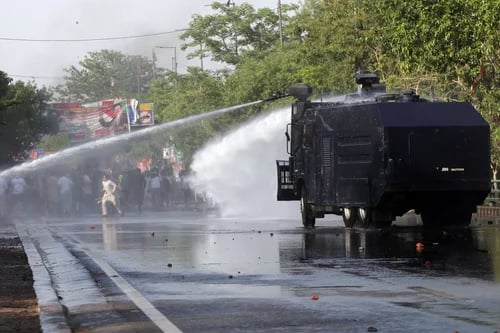
Water-cannon pouring water to disperse civilians protesting against the arrest of their leader, in Lahore, Pakistan, May 9, 2023.
Abduction, Torture, and Detention Without Trial
Families of those detained have reported alarming accounts of enforced disappearances, torture, and prolonged incommunicado detention. Many detainees remain without access to legal counsel, formal charges, or public evidence of wrongdoing. Military courts operate under opaque procedures controlled by the armed forces, denying defendants basic rights to a fair trial. Some civilians have already been sentenced to up to 10 years in prison, despite the absence of verifiable evidence, illustrating the lack of judicial independence and accountability in these proceedings.
Legal Controversy and Constitutional Manipulation
In October 2023, Pakistan’s Supreme Court ruled that military trials of civilians were unconstitutional. However, this decision was controversially overturned in May 2025 through the 26th Constitutional Amendment, enacted by a reconstituted bench. This amendment has been widely criticized for further weakening judicial oversight, effectively granting the military unchecked authority over civilian legal matters, and eroding the separation of powers critical to democratic governance.
Global Condemnation
The international community has strongly condemned Pakistan’s use of military courts for civilians. Governments including the United States, United Kingdom, and European Union, alongside human rights organizations such as Amnesty International and Human Rights Watch, have called for civilian cases to be returned to regular courts. These trials violate Pakistan’s obligations under international human rights law, including the International Covenant on Civil and Political Rights (ICCPR), and pose a serious threat to democracy, justice, and the rule of law.
Summary
The military trials of civilians in Pakistan represent a systemic abuse of power, combining enforced disappearances, torture, and unfair trials to suppress political dissent. This practice not only undermines the independence of the judiciary but also erodes fundamental democratic rights, drawing international condemnation and highlighting the urgent need for reforms to protect civil liberties and the rule of law.
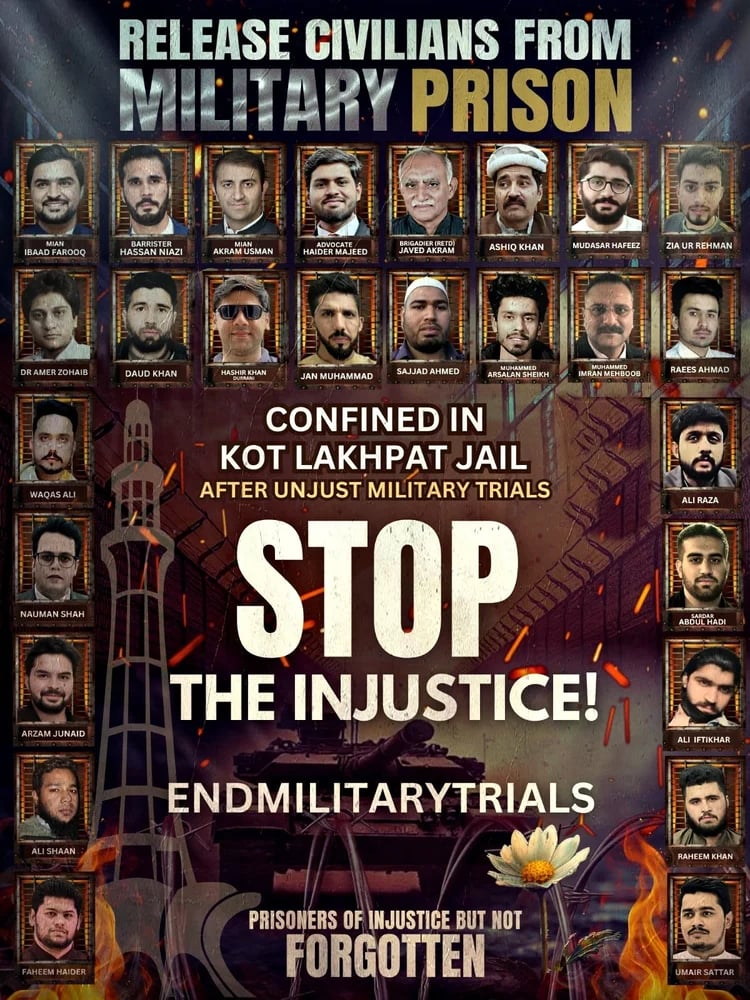
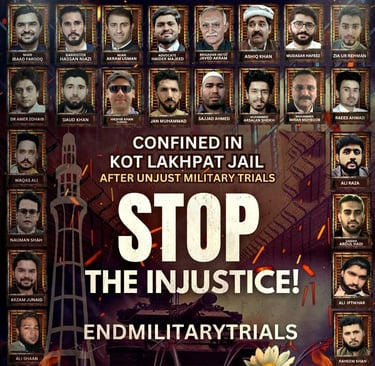
Campaign poster by families of those abducted and kept in military prisons
ABABEEL
Email: support@ababeel.org
Phone: +358 46 9689508
© 2025 ABABEEL